
Military PCB assembly is one of the most demanding areas of electronics manufacturing. Unlike commercial products, military systems must perform reliably in extreme environments such as high vibration, temperature fluctuations, humidity, and even electromagnetic interference.
Because of these strict requirements, choosing a reliable PCB assembly service is critical. Even small defects in assembly or cable integration can lead to system failures in mission-critical applications such as defense communication systems, avionics, radar, and weapon control systems.
Common Issues
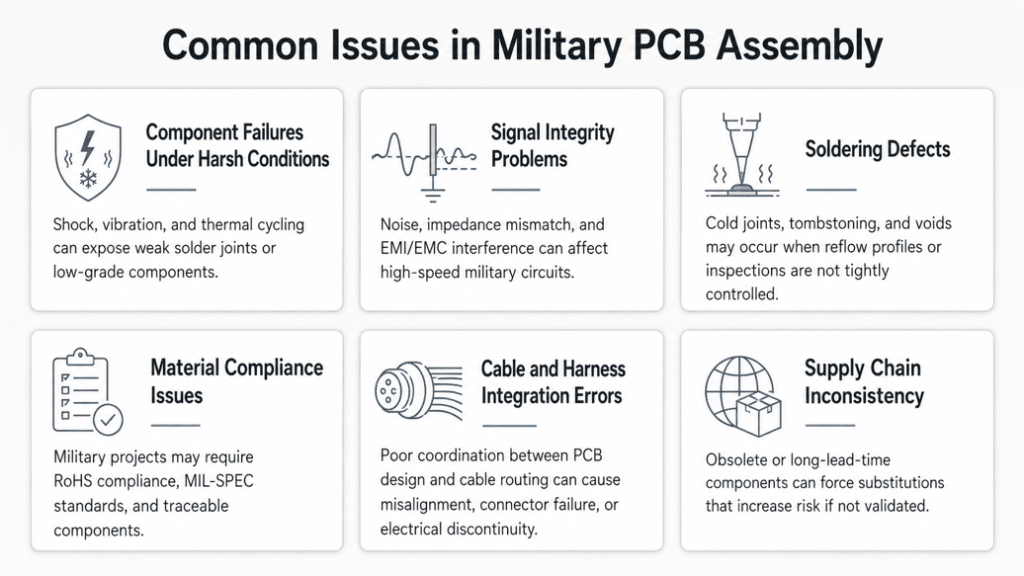
Despite advanced manufacturing processes, several recurring challenges affect military PCB assembly projects:
1. Component failures under harsh conditions: Military electronics often face extreme shock, vibration, and thermal cycling. Poor solder joints or low-grade components can lead to premature failure.
2. Signal integrity problems: High-speed military circuits are sensitive to noise, impedance mismatch, and EMI/EMC interference, especially in densely packed multilayer boards.
3. Soldering defects: Issues such as cold joints, tombstoning, and voids can occur if reflow profiles are not tightly controlled or if boards are not properly inspected.
4. Material compliance issues: Military projects often require RoHS compliance, MIL-SPEC standards, and traceable components. Using non-certified materials can result in rejection.
5. Cable and harness integration errors: Poor coordination between PCB design and cable routing can lead to misalignment, connector failure, or electrical discontinuity—especially when working with military cable assembly manufacturers.
6. Supply chain inconsistency: Obsolete or long-lead-time components can force substitutions, increasing risk if not properly validated.
How We Troubleshoot / Quality Assurance
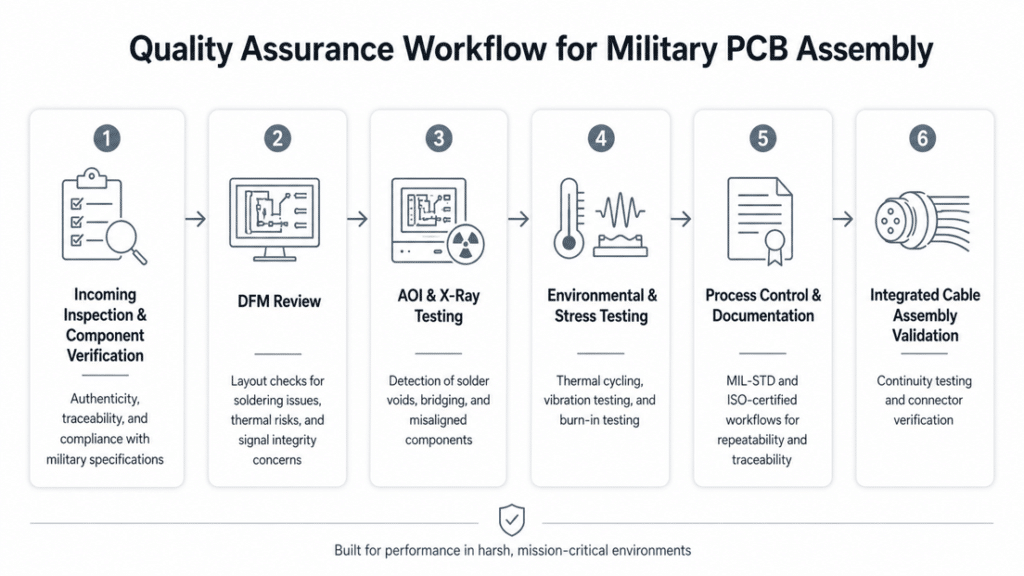
To mitigate these issues, a high-reliability PCB assembly service follows strict engineering and quality control procedures:
- Incoming inspection and component verification: All parts are checked for authenticity, traceability, and compliance with military specifications.
- Automated Optical Inspection (AOI) and X-ray testing: These tools detect hidden defects such as solder voids, bridging, or misaligned components that are not visible to the naked eye.
- Process control and documentation: Strict adherence to MIL-STD and ISO-certified workflows ensures repeatability and traceability across production batches.
- Integrated cable assembly validation: When working with military cable assembly manufacturers, we provide continuity testing and Hipot testing to ensure the cable assembly meets customer requirements.
Work With Us
Military-grade electronics demand precision, consistency, and deep engineering expertise. Whether you are developing defense communication systems, aerospace controls, or rugged field equipment, partnering with a trusted PCB assembly service can significantly reduce risk and improve system longevity.
Stracon provides military PCB assembly and integrated electronic manufacturing solutions designed for mission-critical applications. From prototype to full production, we ensure every board meets strict performance and durability standards.
If you are looking for dependable manufacturing support or collaboration with military cable assembly manufacturers, do not hesitate to contact us. Our team is ready to help.
Contact us today to discuss your project requirements and ensure your systems are built for performance in the harshest environments.
FAQ
Q1: What makes military PCB assembly different from commercial PCB assembly?
Military PCB assembly requires higher reliability standards, stricter testing, and compliance with military specifications such as MIL-STD requirements.
Q2: What certifications are important for a PCB assembly service?
Common certifications include ISO 9001, AS9100 for aerospace/defense, and IPC-A-610 for assembly quality standards.
Q3: Why is cable assembly important in military electronics?
Cable assemblies ensure secure power and signal transmission between systems. Faulty cables can compromise entire mission-critical operations.
Q4: How do manufacturers ensure reliability in harsh environments?
Through rigorous testing such as thermal X-ray inspection, AOI, and full traceability of components.